

Anne H. Brewster's Foreign Correspondence and Private Writing
The exhibit page seeks to showcase the work of Anne H. Brewster as a foreign correspondents who reported about social events, art and architecture for various US American magazines between the 1860s and 1880s (primarily Philadelphia Evening Bulletin and Boston Daily Advertiser). The items collected here also include excerpts from Brewster's letters and diaries as well as writing by others about her, her salon, and her writing, which was reprinted frequently (see, for example, Helen Hunt's letter to Brewster from July 1869).
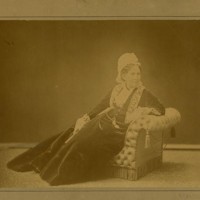
Anne Hampton Brewster

A letter written by Harriet Hosmer to Anne Brewster apologizing about not having the time to return some books that the latter lent to her. She also mentions that she likes Cushman's article.
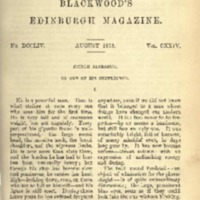
Brewster's account of her relationship with Charlotte Cushman, described as an "intimate friendship".
A letter where Cushman talks about her declining health, convinced she will pass away in a couple of months. She also criticizes Anne Brewster's published letters for their inferior quality.
A letter where Cushman tells Fields about her travel plans and describes Anne Brewster as a "brave woman" who will go to Italy.
A letter where Charlotte Cushman describes Anne Brewster as "an old dear friend of younger days."
An article describing Brewster's outer appearance as well as her Monday receptions, praising her as a great hostess.
An article recounting a studio reception of the artist Healy from Brewster's perspective.
Reprint of a passage written by Anne Brewster in the Philadelphia Bulletin describing the process of Emma Stebbins creating her sculpture for the Central Park in New York.
A reprint from the Philadelphia Bulletin giving insights into the expatriate community of American artists living and working in Rome. It relies on Brewster's own observations and hearsay.
A reprint from the New York World recounting a wedding scandal of the rich Marchese Lezzani family.

A passage from the New York World notes by Brewster about the wedding of the American Countess von Linden in Rome.
A reprint from the Philadelphia Evening Bulletin giving an account of Brewster traveling in France, describing the Church of St. Jean du Duigi in detail.
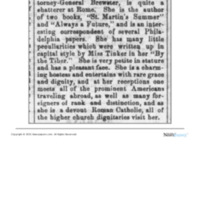
A short entry on Anne Brewster stressing her quality as a hostess and her social circles.
Brewster's biting commentary on the social norms of Vanity Fair drawing from the example of French actress Sarah Bernhardt who offended the upper-class members with her "bad morals."
An article, written by anonymous author who met Anne Brewster and Lucy Hooper first at a fair in Philadelphia together with Mrs. E.D. Gillespie, claiming to have "swapped gossip" when they all met again.
A brief article describing Brewster's life in Rome and portraying her as a great hostess to many Americans and Italians living in Rome.
Short entry reporting that Harriet Hosmer and Anne Brewster go riding together in Rome.
A reprint from the New York World, this article written by Anne Brewster captures the atmosphere of a Roman carnival.
A short entry describing Brewster as a foreign correspondent with "an enviable reputation."
Brewster's obituary, praising her as a foreign correspondent of "rare accomplishments" with a much-frequented home in Rome.
A reprint from the Boston Advertiser, recounting for the public the travels of American artists living in Rome.
A short entry reporting that Brewster has lived in Rome for 20 years and "cannot be persuaded to live anywhere else".
A short entry stating that Brewster "gossips" about American Artists in Rome.
Brewster, as a "regular correspondent", contributes one of her letters from Rome.
An article where Brewster writes about the political struggles for unification.
An article where the author describes Anne Brewster as a "well-known literary person[]" and a woman of "republican simplicity and cordiality" whose Monday afternoon receptions also attract "titled acquaintances."
An article reporting that Brewster attends social gatherings and a funeral in Rome.
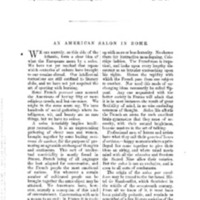
Articles offering a historical genealogy of salons with a specific focus on French salons, but featuring Brewster's salon at Via Quattro Fontane in Rome.
In this book, the author bases the character "Miss Cromo" on Miss Anne Hampton Brewster.
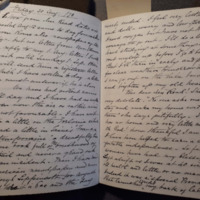
A diary entry, where Anne Brewster writes that she is having "a comfortable independence" and is in a much better position than a year ago.
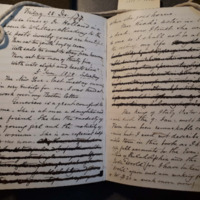
A diary entry, where Brewster writes about her work for the Philadelphia Evening Bulletin and the New York World.
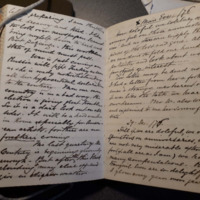
A diary entry, where Brewster describes herself as a solitary old woman and spinster, "in love with my solitary life."
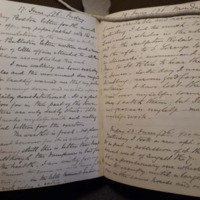
A diary entry, where Brewster writes about health and financial concerns.
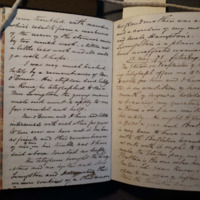
Diary entry excerpts about discussions of illness, Brewster's anticipation of death, social networking, and payment negotiations with the Philadelphia Evening Bulletin and the Evening Telegraph.
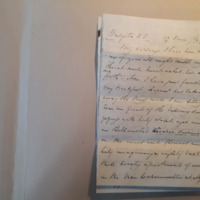
A letter where Anne Brewster reminisces about her days in Naples and advises Mary Howell to go with Charlotte Cushman to Rome, a trip for which Cushman will apparently pay.
A letter where Helen Hunt mentions that Brewster's articles are being quoted in different newspapers and tells her how much that increases the value of her work.
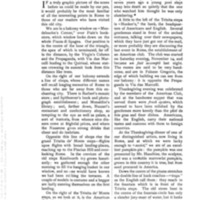
An article written by Brewster where she describes her experiences in Rome and also talks about other American Artists in Rome including Cushman, Hosmer and Stebbins.
A summary of articles in a recent issue of Lippincott's Magazine claiming that Tincker's novel By the Tiber has sparked immense interest in Anne Brewster and her network.
A letter where Anne Brewster advises Mary Agnes Tincker who is about to publish By the Tiber in 1881, a novel which includes references to Brewster and her circle in Rome, to stick to the truth whenever Tincker refers to something that has been talked about by the two women.
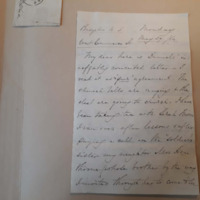
A letter where Brewster writes that she has received an unaffected letter from Cushman and mentions that she has the Hawthornes as neighbors.
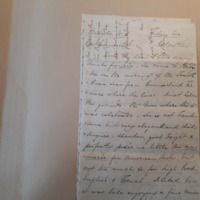
A letter in which Anne Brewster expresses the sentiment of her being drawn to her counsin Frank's fiancée.
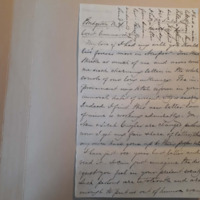
A letter in which Brewster writes about meeting a bishop, other encounters, and her novel St. Martin's Summer.
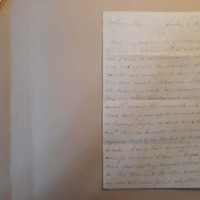
A letter where Brewster writes about her social duties and her correspondence with Cushman, who has repeatedly invited her to her home in England.
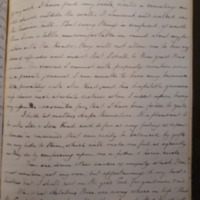
A diary entry, where Brewster writes about her relationship to the Reads and also mentions how some issues cannot be put down in a diary.
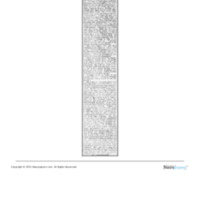
A reprint from Brewster's article for the Boston Advertiser, this one speaks of Cushman’s performance as Nancy Sykes before she went to England.
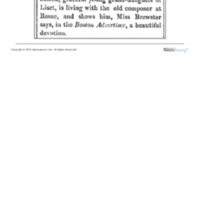
A short entry referencing Brewster's article for the Boston Advertiser and reporting that composer Franz Liszt's granddaughter, Baroness von Bulow, is staying with the former at his residence in Rome.
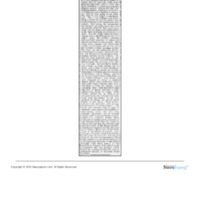
A reprint from the Philadelphia Bulletin, this article written by Brewster speaks of the Pope's health and habits.
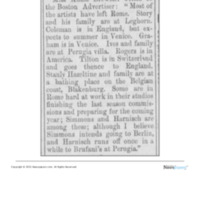
A reprint of a part of Brewster's article for the Boston Advertiser in which she lists US-American artists who left Rome to spend the summer elsewhere.
A reprint of Brewster's article in the Phildelphia Bulletin describing Alma Tadema's studio in Rome.
A reprint of Brewster's letter in Boston Advertiser recounting a quarrel between the Saxon Duchess Marguerite and King Victor Emmanuel.
An article describing Anne Brewster as "the accomplished correspondent" and a salonnière at Rome, Palazzo Maldura.
A collection of reviews from different periodicals praising Brewster as a "cultivated mind" and her book St. Martin's Summer as a "record of feelings."
A reprint from the Philadelphia Bulletin, this article written by Brewster describes comfortable living in Rome, differentiating between more and less affluent people.